Most advice for this is about motivation. That is the wrong problem. If you are three assignments behind with two more landing this week, you do not need encouragement — you need to decide what is not going to get done, on purpose, before it gets decided for you at 2am.
The instinct that makes it worse
Almost everyone starts with the oldest overdue thing. It feels like clearing a debt. It is usually the worst available move, for two reasons.
The old assignment has already taken its penalty and, in most courses with a percentage policy, has stopped getting worse — many cap out at 50% or 60%. The new one is still worth full marks. Every hour spent on the old one is bought from something that could have scored higher.
And overdue work is often worth less than it feels. A three-day-late discussion post in a 5% category is a rounding error. It occupies far more of your attention than of your grade.
Sort by what is still winnable
Write down everything outstanding with two numbers: what it is worth, and whether it can still score full marks. Then work in this order.
| 1 | Not yet due, high weight | Full marks still available. This is where hours convert best. |
| 2 | Not yet due, low weight | Cheap to finish and stops the pile growing. |
| 3 | Late but uncapped | Still losing points by the hour, so finishing it saves something. |
| 4 | Late and already floored | Cannot get worse. Do it last, or not at all. |
The uncomfortable part is row four. Something that is late, capped, and worth little is a candidate for not doing at all — and deciding that deliberately is better than doing it badly at midnight while the thing in row one goes unstarted.
Half-doing is a real strategy
The marks in most assignments are front-loaded. Getting from nothing to a competent attempt captures most of what is available; getting from competent to polished captures the rest, and costs about as much again.
When you are behind, take the first half on several things rather than the whole of one. Three assignments at 75% beat one at 95% and two at zero, and it is not close.
This is also where a rubric earns its keep. If 40% of the marks are for analysis and 20% for formatting, and you have three hours, you know exactly which one to skip.
Tell someone, early
Before the deadline you are a student managing a bad week. After it, you are explaining a missed one. The same message lands completely differently depending on which side of the date it arrives on, and instructors have far more discretion before than after.
Ask for something specific: a named assignment, a date, a time. How to word it is its own short guide.
Stop the next one
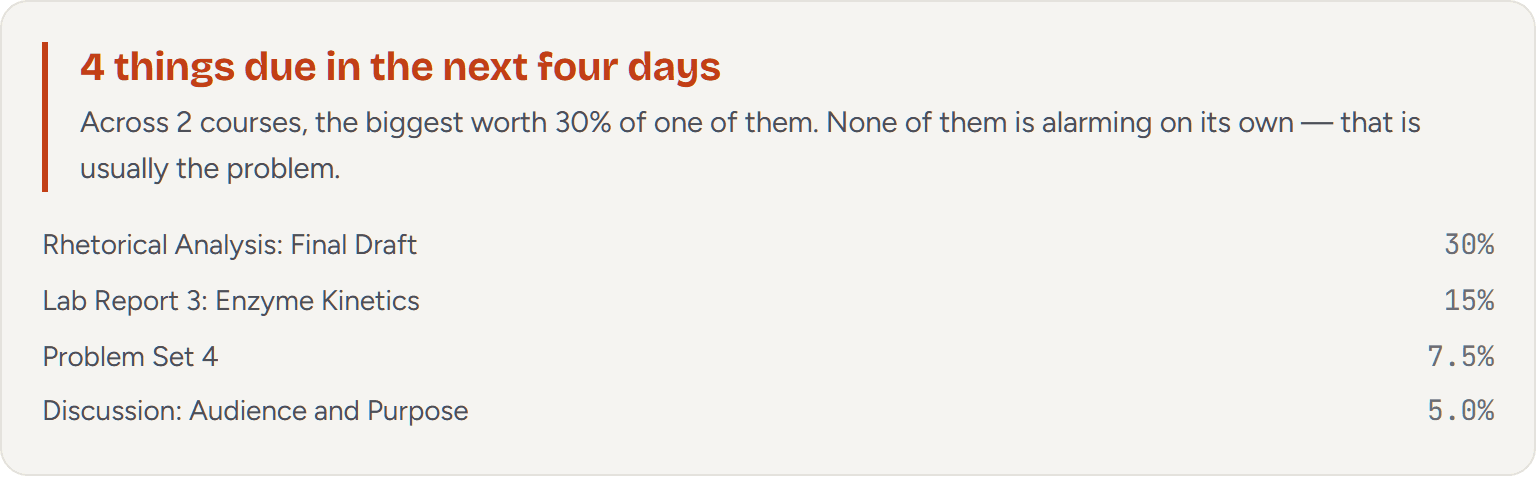
Falling behind is rarely one bad decision. It is usually a week where several things landed together, none of them individually alarming, and nothing added them up. Once you are through the current pile, the useful move is to look a week out and find the next collision while there is still room in front of it.
Related
What a late submission actually costs covers the floors that make row four a real option, and why weeks collapse covers how the pile forms.