Ask anyone who had a bad semester what went wrong and you will hear about one assignment. The paper they could not start. The project that ran away from them. It is almost never actually that.
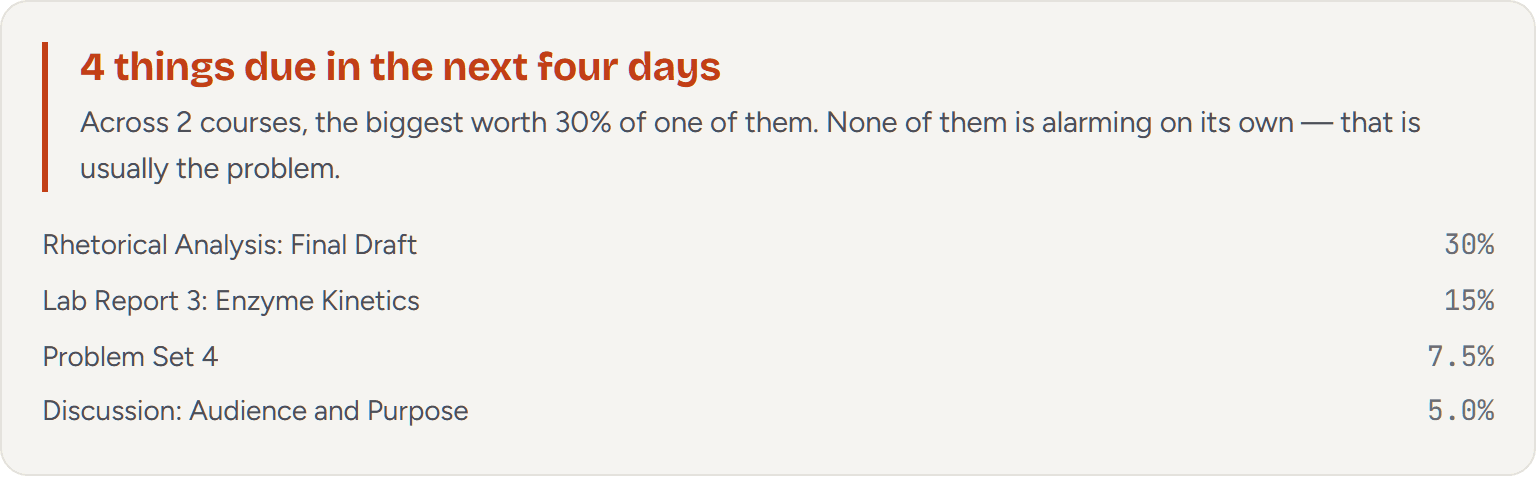
What happens instead is that four unremarkable pieces of work land in the same forty-eight hours. Each one was assigned weeks earlier. Each one had a reasonable deadline. Not one of them looked dangerous on the day it appeared. Together they did not fit, and nothing you were looking at was capable of telling you that.
Why no calendar catches it
Every tool students use — Canvas’s own dashboard, a to-do app, a paper planner — shares one blind spot. They store deadlines. A deadline is a point in time. It carries no information about how long the work takes.
So a calendar can show you four items on Thursday and it looks exactly like four items on any other Thursday. Whether that is two hours of work or twenty-nine is not a fact the calendar has. You supply that from memory, for each item separately, and the arithmetic never gets done.
The hours you actually have
The second half of the problem is that a 48-hour window is not 48 hours. Sleep takes about sixteen. Class and getting to it takes another ten or so. Eating, a shift, a commute and the ordinary friction of being a person take most of what is left.
What remains is usually somewhere around a quarter of the window. Two days sounds like plenty of time for a twenty-nine hour pile of work right up until you write down that you have twelve hours to do it in.
This is why “I have until Thursday” is such a reliable way to be wrong. Thursday is sixty hours away and contains about fifteen usable ones.
Four things that make it worse
Assignments cluster by design. Courses hit midterms at the same point in the term, and instructors avoid the same holidays. Your five courses independently converge on the same weeks without any of them knowing.
Discussion posts hide their real cost. A discussion is usually worth few points and looks like a fifteen-minute job. Then it needs a reading done first, two substantive replies, and a return visit two days later. Several of those in a week is most of a day.
Group work fails silently. The deadline that matters for a group project is not the submission date, it is whenever the group needed your part. Nothing shows you that one, and going quiet costs you standing with people you have to work with for another two months.
The warning arrives after the fact. By the time a grade drops, the week that caused it is already gone. Grades are the slowest possible signal for a problem whose entire lifespan was three days.
What actually helps
Count the work, not the hours. The obvious move is to put an hour estimate beside each item and add them up, and it does not survive contact with reality. How long a discussion post takes varies by an order of magnitude between two people in the same class, and it has moved again now that most students draft with AI. An estimate that is wrong by 5x is worse than no estimate, because it gets trusted. What does not lie is the count and the points: four things worth 175 points inside two days is a hard week whoever you are.
Read the requirement before the deadline. Most weeks that go wrong do not go wrong because the work was long. They go wrong because the thing turned out to be different from what it looked like on the calendar — a discussion that needs two peer replies on separate days, an assignment whose rubric awards most of its points for something the title never mentions. The prompt and the rubric are both sitting in Canvas the whole time. Reading them on the day the work opens costs ten minutes and is the single highest-return habit here.
Work a seven-day horizon. A collision is only fixable while there is still room in front of it, so it has to be visible before the week it lands in. But a term-long list is its own problem: everything is on it, nothing is urgent, and it stops being read by week three. Seven days is far enough ahead to move something and short enough to still mean anything.
Decide what gives, deliberately. When a week genuinely does not fit, something is going to be worse than it should be. Choosing which — the low-weight discussion rather than the exam prep — is a much better outcome than finding out at 2am which one ran out of time on its own.
Related
If the immediate question is a specific grade rather than a specific week, the final grade calculator answers that in two numbers.