A syllabus reads like a stream. Week one, week two, week three, a steady flow of work spread across the term. The calendar underneath it does not look anything like that.
Fifty-nine deadlines, eighteen nights
Read off a real enrolled account across six months: 59 assignments carried a due date. They fell on 18 distinct dates. Every single one was a Saturday or a Sunday. Every single one was due at 11pm.
Not most. All 59. There is no weekday deadline anywhere in six months of coursework, and no deadline at any hour other than 23:00.
Adding a course does not spread the load
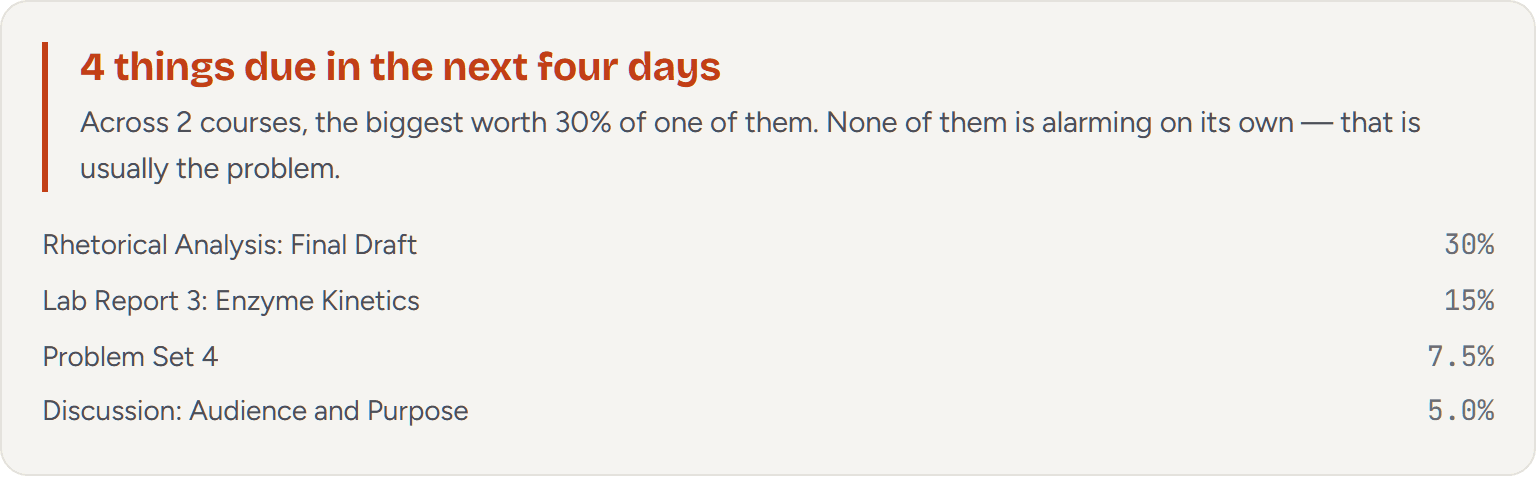
This is the part worth knowing before you register. For the first nine weeks only one course on the account was setting work, and each Sunday carried one to three things. A second started in August. From that point every Sunday carried four or five.
The second course did not add work between the existing deadlines. It added it to the same night. Both courses run a weekly cadence, both chose Sunday, and both chose 11pm — independently, without reference to each other, because neither knows the other exists.
There is not one week in the whole term where one course’s deadline lands on a different day to the other’s. Not one.
Why this is worse than it sounds
Five things due at the same hour is not five times one thing. Each has its own prompt to re-read, its own rubric, its own submission format. The switching cost is real and it is paid five times.
It also concentrates the risk. A weekend where something goes wrong — illness, work, a family thing, a laptop dying — does not cost you one assignment. On this calendar it costs you five, from two different courses, on the same night.
And none of it is visible in advance. Each course’s page shows a tidy weekly list. The collision only exists when you put the two lists side by side, which is a thing Canvas does not do for you.
What actually helps
Find the collisions before the term starts. Put every due date from every syllabus into one list, sorted by date, and count what lands on each night. Ten minutes in week one, and you know which weekends of the term are the dangerous ones.
Treat the deadline as the last resort, not the plan. When five things share a night, finishing anything early is worth more than doing anything well the day of. The cheapest item to move is the smallest one.
Know which of the five actually matters. On a night with five submissions, they are rarely worth the same. One is often worth ten times another, and the points on the assignment will not tell you which.
Related
The other half of this is what happens after the pile-up — why weeks collapse covers how one bad weekend becomes a bad month, and what to do when you are already behind is for when it has.