You add up your scores, get one number, and Canvas shows a different one. It is almost never a bug. It is almost always one of six things, and which one it is determines whether you should do anything about it.
The six causes
Ungraded work is being ignored
The most common by far.
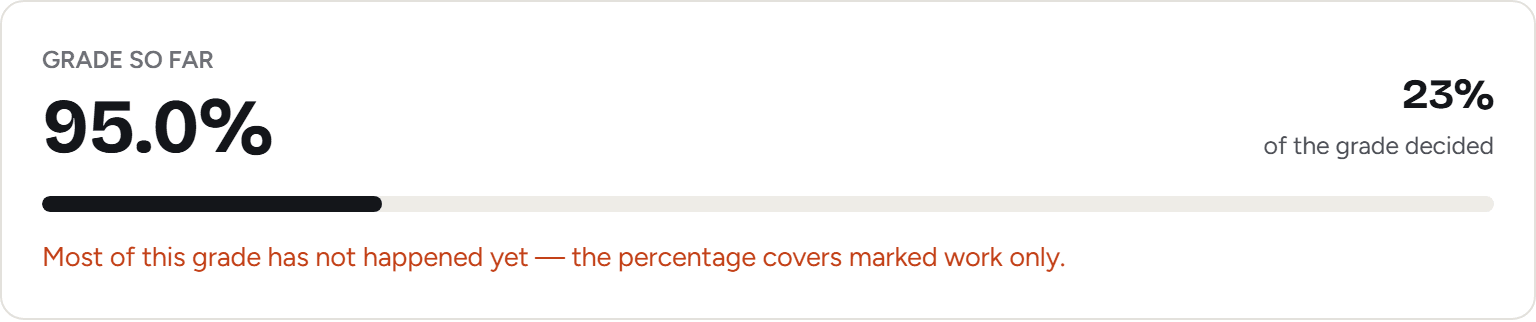
Canvas averages what has been marked. Anything not yet graded — including work you never submitted, until an instructor enters the zero — is left out entirely rather than counted as nothing. This is why grades drift downward all term rather than upward.
The course is weighted
And you added up raw points.
If categories carry weights, point totals stop being the answer. Five hundred points of perfect homework in a 10% category moves your grade less than one exam in a 60% one.
A lowest score is being dropped
And not the one you expect.
Canvas drops whichever assignment leaves you with the best grade, which is frequently not your lowest percentage. A 50% on a hundred-point midterm can be dropped ahead of a zero on a one-point quiz.
Something is excused
Shown as EX rather than a score.
An excused assignment is removed from the calculation on both sides — it is not a zero and not full marks. Your denominator is smaller than the syllabus implies.
Grades are entered but not posted
You cannot see them at all.
Instructors can hold marks behind a manual posting policy and release them together. During that window the work is graded, your total does not reflect it, and nothing on your screen says so.
It was marked outside Canvas
A spreadsheet, or by hand.
Plenty of instructors calculate the real grade themselves and use Canvas only as a dropbox. If the syllabus describes a scheme Canvas is clearly not applying, this is usually why.
Working out which one you have
Open Grades and count what is missing. If a large share of the term has no score next to it, cause one explains most of the gap and there is nothing to fix — the number is just early.
Check whether the course is weighted. Assignments, then the assignment-groups view. Percentages next to the group names mean your point arithmetic was never going to match.
Look for struck-through rows. Canvas usually marks dropped assignments visually. If one is dropped, recompute without it before concluding anything.
Look for EX. Excused work changes the denominator, which is the least intuitive of the six.
| Raw points, everything counted | 72.5% |
| Ignoring the three ungraded items | 91.0% |
| Weighted, ignoring ungraded | 88.4% |
| Weighted, ungraded, one dropped | 90.7% |
Eighteen points between the first row and the last, on identical scores. This is why “my grade looks wrong” is usually a question about which calculation is running rather than about the numbers.
When it really is wrong
Occasionally it genuinely is: a score typed into the wrong row, weights that do not match the syllabus, a drop rule configured on the wrong category. Instructors set these up by hand at the start of term and mistakes happen.
If you think you have found one, send the specific discrepancy rather than a general worry — which assignment, what you expected, what Canvas shows. That is checkable in thirty seconds, and a checkable message gets answered.
Related
How drop-lowest actually works covers cause three in full, and why an early 100% means little covers cause one.