There are two completely different ways a Canvas course can compute your grade, and which one you are in changes what every assignment is worth. Most students never find out which one they are in, which is how you end up grinding out a perfect homework record that moves your grade by half a point.
Points versus weights
In a points-based course, your grade is just everything you earned over everything available. A hundred-point exam is worth exactly ten ten-point quizzes. Nothing else is going on.
In a weighted course, assignments are sorted into groups — Homework, Quizzes, Exams — and each group is assigned a percentage of the final grade. Your score within a group is worked out first, then those group percentages are combined according to their weights. The raw point totals stop mattering almost entirely.
| Group | Your score | Weight |
|---|---|---|
| Homework | 500 / 500 — 100% | 10% |
| Exams | 140 / 200 — 70% | 90% |
Points-based: 640 / 700 = 91.4%
Weighted: (1.00 × 0.10) + (0.70 × 0.90) = 73.0%
Identical work. An eighteen point difference, and the difference between an A− and a C. Five hundred points of flawless homework is worth a tenth of the grade because someone typed 10 into a box.
Finding your actual weights
Open the course in Canvas and go to Assignments. Assignments are listed under their group headings. If the course is weighted, each group header shows a percentage — Exams 60% and so on. If there are no percentages, the course is points-based and every point is equal.
You can also open the three-dot menu at the top of the Assignments page and choose Assignment Groups Weight, which lists all groups and their weights in one dialog.
When the syllabus and Canvas disagree
They disagree more often than you would expect. A syllabus is written before the semester and edited by hand; the Canvas weights are configured separately and sometimes not at all. Courses get copied from previous terms with last year’s numbers still in them.
When they conflict, Canvas is what is running. It is the thing computing the number that becomes your grade. The syllabus is a description of intent; the gradebook is the implementation.
That said, a mismatch is worth an email. It is usually a configuration slip rather than a decision, and instructors generally want to know — but it will not fix itself, and every week it stays wrong is a week you are planning against the wrong numbers.
Three things that trip people up
Weights that do not add to 100. Canvas allows it. If your groups total 90%, the grade is computed over that 90 and scaled, which quietly inflates everything. If they total 110, the reverse. Worth adding up.
Empty groups. A group with a weight but no graded work in it yet is excluded from the calculation entirely rather than counted as zero. This is a large part of why early-semester percentages look so good.
Extra credit. In a weighted course, extra credit only helps within its own group, capped by that group’s weight. Extra credit dropped into a 5% participation group cannot rescue an exam average no matter how much of it you do.
What to do with this
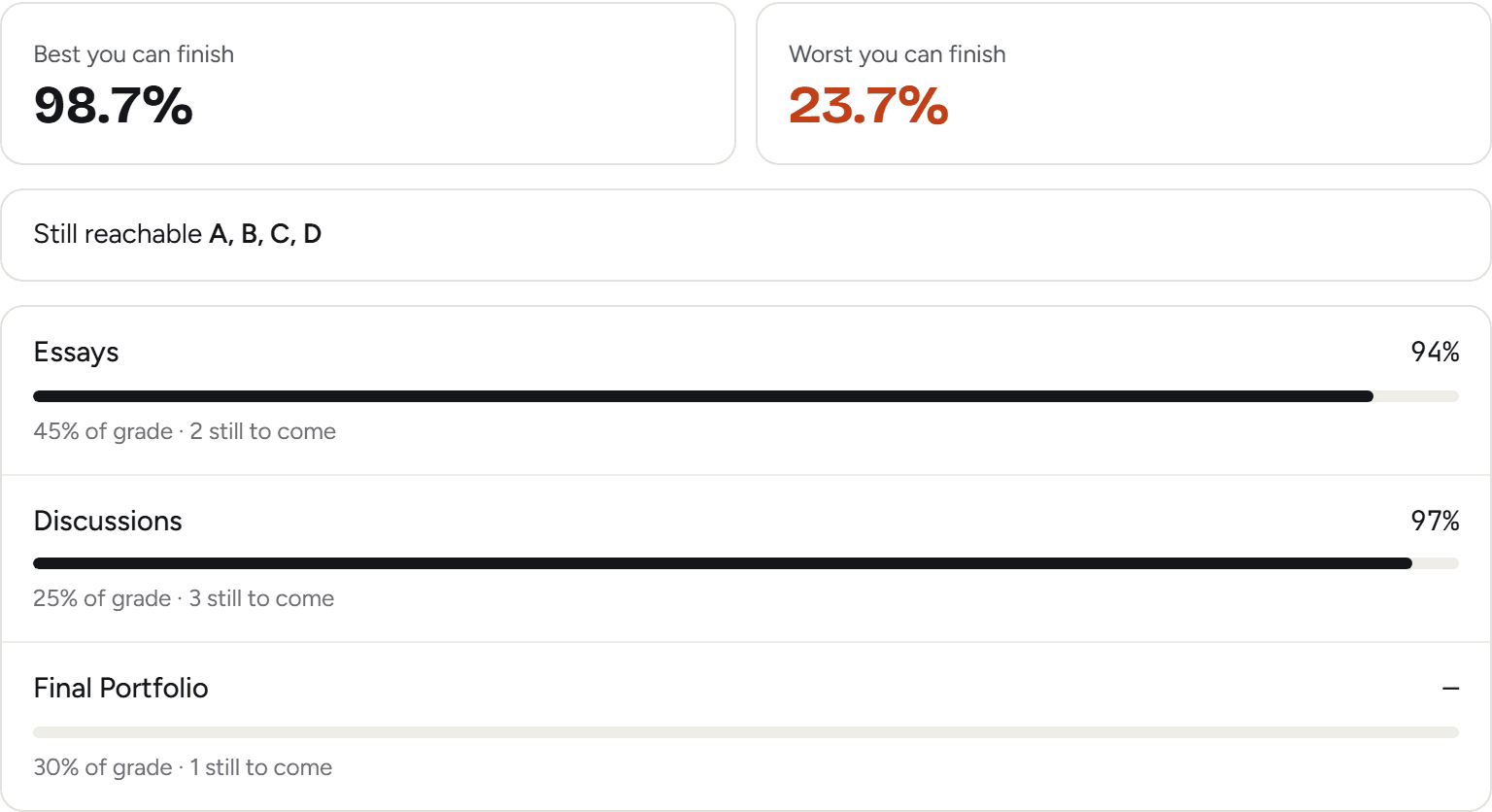
Once you know your weights, the useful move is to rank your remaining work by weight per hour rather than by points or by deadline. A twelve-hour project inside a 10% group and a three-hour exam prep inside a 60% group are not close, and the points on the assignment page will tell you the opposite.
Related
Weighted groups are also where drop-lowest rules get strange, and why an early 100% means so little.